
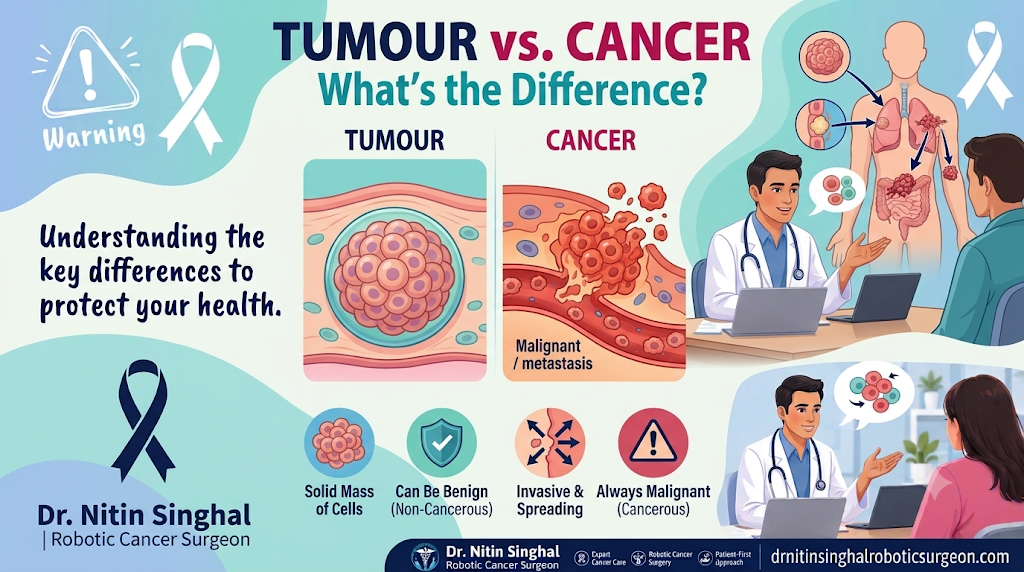
Is Every Tumour Cancer?
Quick Answer : No, A tumour is an abnormal mass of tissue. It may be benign or malignant. Cancer refers to cells that grow abnormally and can invade nearby tissue or spread to other parts of the body. Also, not every cancer forms a lump: leukaemia, for example, usually affects blood-forming tissues rather than creating a solid tumour.
What Is a Tumour?
A tumour (also called a neoplasm) is a mass of tissue that develops when cells multiply more than they should or do not die when they normally would. Tumours can occur in many parts of the body. The word describes a growth; by itself, it does not tell you whether the growth is cancerous.
A doctor interprets a lump alongside your symptoms, examination, medical history and test results. Depending on its location and appearance, an ultrasound, CT scan, MRI, blood test or tissue sampling may be recommended.
What Are the Different Types of Tumours?
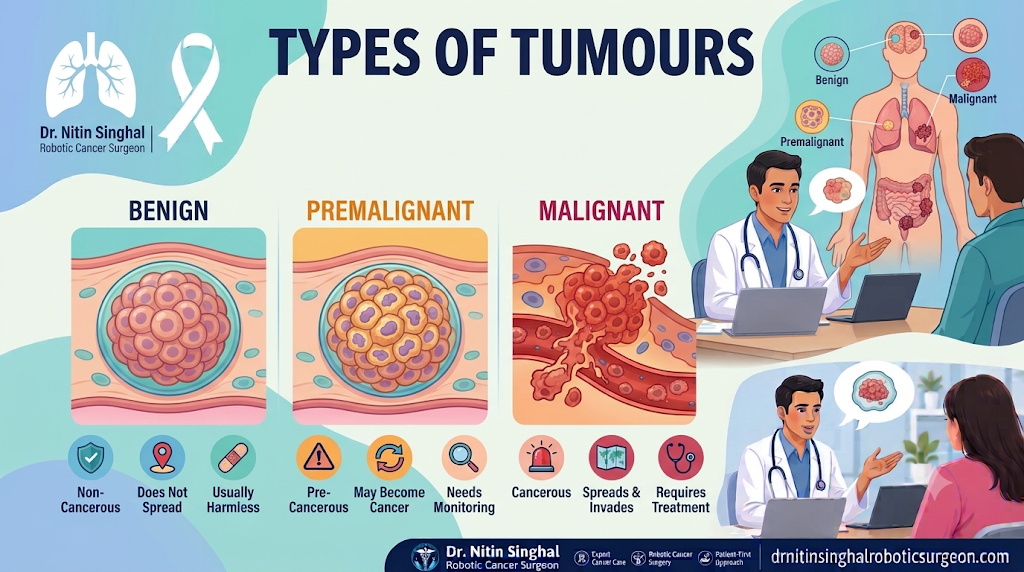
1. Benign tumours
Benign tumours are non-cancerous. They do not invade nearby tissues or spread to distant organs. Examples include many lipomas (fatty lumps), uterine fibroids and breast fibroadenomas. Many are monitored rather than treated, although removal may be considered if a tumour causes pain, bleeding, pressure on an organ, functional problems or continued growth. Most thyroid nodules are not cancer, but they still need assessment based on clinical and ultrasound features.
2. Precancerous changes and lesions
Some abnormal cell changes are not invasive cancer but may carry a risk of developing into cancer. Examples include certain colon polyps and some forms of cervical dysplasia. The risk varies by the type, grade and other clinical factors; not every polyp or abnormal cell change will become cancer. Follow-up, removal or treatment depends on the specific diagnosis. White or red patches in the mouth should be assessed by a qualified clinician rather than assumed to be precancerous.
3. Malignant tumours
Malignant tumours are cancerous. Their cells can invade surrounding tissues and, in some cancers, spread through the blood or lymphatic system to distant organs. This spread is called metastasis.
What Is Cancer?
Cancer is a group of diseases in which abnormal cells grow uncontrollably and may invade nearby tissues or spread to other parts of the body. Most cancers begin in cells and tissues that form a solid tumour, but blood cancers such as leukaemia generally do not form a typical solid lump. Some cancers, including certain early or in-situ conditions, have specific definitions and behaviour, so the exact pathology report matters.
Tumour vs Cancer: Key Differences
| Feature | Benign tumour | Malignant tumour (cancer) |
| Meaning | Non-cancerous growth | Cancerous growth |
| Invasion | Does not invade nearby tissue | Can invade nearby tissue |
| Spread to distant organs | Does not metastasise | May metastasise, depending on cancer type and stage |
| Growth rate | Often slow, but can vary | Can be slow or fast; varies by cancer |
| Appearance on scans | May have well-defined borders | May have irregular features, but imaging alone cannot confirm cancer |
| Treatment | May be monitored or treated if needed | Treatment is planned according to cancer type, site and stage |
| After treatment | Recurrence depends on tumour type and whether it was completely removed | Follow-up is planned because recurrence risk varies by cancer and treatment |
| Does it form a lump? | Usually a localised mass | Many solid cancers form masses; blood cancers may not |
Important: Can You Tell Whether a Lump Is Cancer by Touch or Growth?
No. A hard, fixed, painless or rapidly growing lump deserves medical assessment, but none of these features alone proves cancer. Some benign lumps can feel firm or grow, while some cancers may be painless or grow slowly. Similarly, smooth borders on a scan can be reassuring but do not provide a diagnosis on their own.
The safest approach is not to judge a lump by appearance, pain or growth rate. Arrange an examination if you notice a new lump, a change in an existing lump, unexplained swelling or another persistent symptom.
What Are the Different Types of Cancer?
| Cancer type | Where it begins | Examples / notes |
| Carcinoma | Cells lining the skin or internal organs | Includes many breast, lung, bowel and bladder cancers |
| Sarcoma | Bone or soft/connective tissues such as muscle and fat | Includes bone and soft-tissue sarcomas |
| Leukaemia | Blood-forming tissues, including bone marrow | Often does not form a solid tumour |
| Lymphoma | Lymphocytes, a type of immune cell | May involve lymph nodes or other lymphatic tissues |
| Melanoma | Pigment-producing cells (melanocytes) | Often begins in the skin; changing pigmented lesions need assessment |
What Causes Cancer?
Cancer develops when changes in the DNA and control systems of cells allow abnormal growth and survival. Some people inherit gene changes that increase risk, while many changes occur during life through a combination of ageing, exposures and chance. Having a risk factor does not mean a person will definitely develop cancer, and cancer can occur in people without obvious risk factors.
Important risk factors include tobacco in smoked and smokeless forms (including gutkha and chewing tobacco), alcohol, excess body weight, physical inactivity, some dietary patterns, air pollution, ultraviolet and other radiation exposures, and certain infections. HPV and hepatitis B and C are examples of infections associated with particular cancers. Vaccination against HPV and hepatitis B is recommended for eligible groups under local medical guidance.
Genes Linked to Cancer
| Gene group | Normal role | What can happen when altered |
| Oncogenes | Help regulate cell growth and division | Certain changes can keep growth signals switched on |
| Tumour-suppressor genes | Help slow cell division, repair damage or trigger cell death | Loss of function can remove important growth controls |
| DNA-repair genes | Help detect and repair DNA damage | Faulty repair can allow DNA errors to accumulate; inherited BRCA1/BRCA2 changes can increase the risk of certain cancers |
How Does Cancer Spread?
Cancer can spread in three broad ways:
1. Direct invasion: cancer cells grow into nearby tissues or structures.
2. Lymphatic spread: cells enter lymph vessels and may reach nearby lymph nodes.
3. Bloodstream spread: cells travel through blood vessels and may establish cancer deposits in distant organs.
When cancer forms a new growth in another organ, it is called metastatic cancer. The secondary growth is made of the original cancer cell type—for example, breast cancer that spreads to the lung is metastatic breast cancer, not a new primary lung cancer.
How Are Tumours and Cancer Diagnosed?
There is no single test that diagnoses every cancer. Assessment may include a medical history, physical examination, blood tests and imaging such as ultrasound, CT, MRI or PET scans. For many solid tumours, a biopsy is needed: a tissue sample is examined by a pathologist to identify the cells and determine whether cancer is present. Some blood cancers are diagnosed using blood, bone marrow and other specialised tests.
A scan can help identify the size, location and features of a growth, and may guide the next step. It cannot always distinguish benign from malignant tissue with certainty. Your specialist will recommend tests based on the suspected condition.
Treatment: Does Every Tumour Need Surgery?
No. Many benign tumours only need observation or periodic imaging. Others may require medication, a procedure or surgery if they cause symptoms, affect organ function, grow or have uncertain features.
Cancer treatment is individualised. Depending on the cancer type, location, stage, tumour biology and the person’s overall health, options may include surgery, radiotherapy, chemotherapy, hormone therapy, targeted therapy or immunotherapy. Some patients need a combination of treatments; others may not need surgery.
For selected cancers, minimally invasive or robotic-assisted surgery may be an option. Suitability depends on the diagnosis, anatomy, stage and the treating team’s assessment. Robotic surgery is not appropriate for every patient and does not replace the need for an individual treatment plan.
When Should You See a Doctor About a Lump?
Arrange a medical assessment if you notice a new lump or swelling, a lump that is getting bigger, a persistent change in the breast or testicle, a non-healing mouth ulcer, a persistent white or red patch in the mouth, unexplained bleeding, or another symptom that does not settle. Seek advice sooner if symptoms are worsening or you are concerned. Do not wait for pain: some cancers are painless in their early stages.
A tumour is a growth; it is not automatically cancer. Benign tumours do not spread, while malignant tumours are cancer and can invade nearby tissue or metastasise. Some precancerous changes may need monitoring or treatment, and some cancers—such as leukaemia—do not form a solid lump.
The right diagnosis comes from a proper medical assessment and, when indicated, appropriate laboratory, imaging and pathology tests. If you have found a lump or received an unexpected scan report, speak with a qualified doctor rather than trying to diagnose it yourself.
Meet the Expert
Dr. Nitin Singhal is a robotic and surgical oncologist in Ahmedabad. His clinical practice includes the surgical management of cancers involving the abdomen, chest, head and neck, breast, and gynaecological and urological organs.
Book a consultation with Dr. Nitin Singhal
Frequently Asked Questions
1. Is every tumour cancer?
No. Tumours can be benign (non-cancerous) or malignant (cancerous). The term tumour alone does not establish a cancer diagnosis.
2. Can a benign tumour become cancer?
Most benign tumours do not turn into cancer. Some separate precancerous lesions, such as certain colon polyps, can develop into cancer over time. Their risk depends on the specific findings.
3. How do I know if my lump is cancer?
You cannot reliably tell by touch, pain or growth rate. A clinician may recommend examination, imaging and, when appropriate, a biopsy or other tests.
4. Does a biopsy spread cancer?
For most routine diagnostic biopsies, the risk of tumour seeding is extremely low. The procedure and any specific risks depend on the suspected cancer and biopsy method. Discuss concerns with the treating specialist; do not delay recommended diagnosis.
5. Are cancerous lumps painful?
Not always. Some are painless, especially early on. A persistent or changing lump should be assessed even if it does not hurt.
6. What is the difference between a cyst and a tumour?
A cyst is generally a sac that may contain fluid, air or semi-solid material. A tumour is an abnormal tissue growth and may be benign or malignant. Imaging and sometimes further tests help distinguish them.
7. Can cancer be cured?
Some cancers can be cured, particularly when diagnosed early and treated appropriately. Outcomes vary by cancer type, stage, biology and available treatment. Some advanced cancers can be controlled for extended periods.
8. Can you have cancer without a lump?
Yes. Blood cancers such as leukaemia usually do not form a typical solid tumour. Some other cancers may also be difficult to feel as a lump.
Conclusion
A tumour is not always cancer. While benign tumours do not spread, malignant tumours can invade nearby tissues and spread to other organs. Early diagnosis and timely treatment are essential for better outcomes. If you notice a persistent or unusual lump, consult a specialist for proper evaluation.