
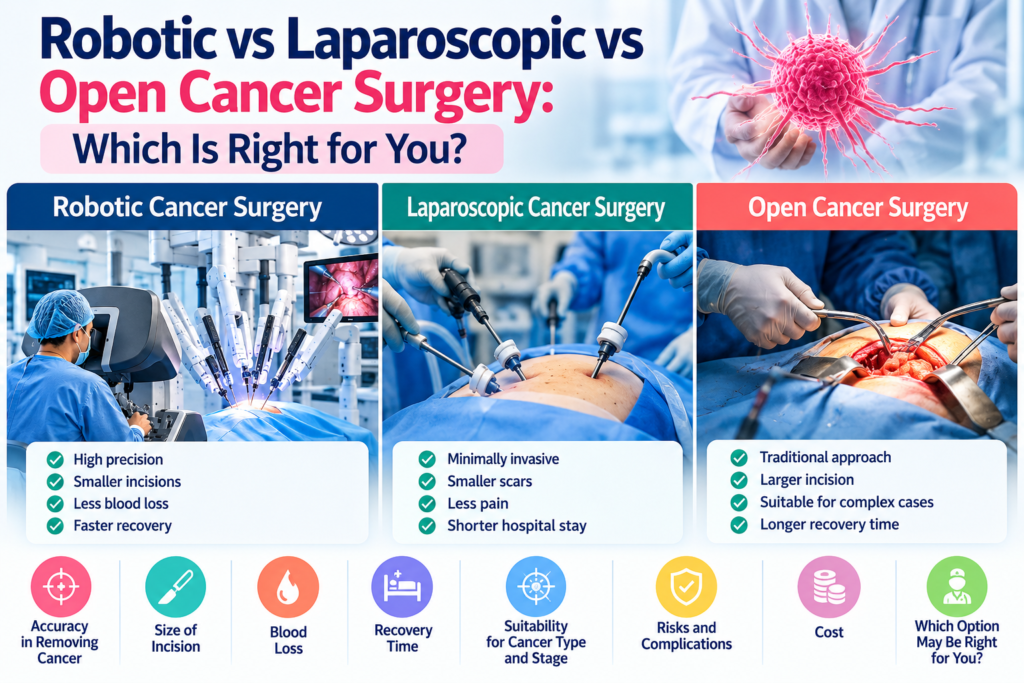
What is open surgery?
In open surgery, the surgeon makes one larger incision and operates directly with their hands and instruments. It has been the standard for decades and remains the right choice in some situations, for example very large tumours, cancers that have spread to several nearby organs, or emergencies.
The main drawback is the size of the cut. A larger incision usually means more pain, a longer hospital stay, more blood loss and a longer return to normal life.
What is laparoscopic (keyhole) surgery?
Laparoscopic surgery uses 3–5 small cuts. A thin camera and long, straight instruments are passed through them, and the surgeon watches a 2D screen while operating.
Compared with open surgery, patients usually have less pain, smaller scars and a faster recovery. The limits are on the surgeon’s side: the instruments do not bend like a wrist, the image is flat, and working deep in narrow spaces such as the pelvis can be difficult.
What is robotic surgery?
Robotic surgery is also keyhole surgery, but the instruments are held by robotic arms that the surgeon controls from a console in the same operating theatre. The robot does not operate on its own. Every movement comes from the surgeon’s hands.
What the robot adds:
- 3D high-definition, magnified view of the operating area
- Wristed instruments that bend and rotate more than a human wrist
- Tremor filtering, which steadies fine movements
- Better access to tight spaces such as the pelvis, the area behind the stomach, or deep in the throat
This is why robotic surgery is especially useful for operations such as prostate cancer surgery, rectal and colon cancer surgery, and complex procedures like the robotic Whipple procedure for pancreatic cancer.
Side-by-side comparison
| Factor | Open surgery | Laparoscopic surgery | Robotic surgery |
|---|---|---|---|
| Incision | One large cut | 3–5 small cuts | 3–6 small cuts |
| Surgeon’s view | Direct | 2D screen | 3D, magnified |
| Instrument movement | Full hand movement | Straight, limited | Wristed, very flexible |
| Pain after surgery | More | Less | Less |
| Hospital stay | Usually longest | Shorter | Often shortest |
| Best suited for | Very large or widespread tumours, emergencies | Many routine and some cancer operations | Deep, narrow areas and precise cancer operations |
| Cost | Lower | Moderate | Higher |
Recovery figures vary from patient to patient. Your surgeon can tell you what to expect for your own operation.
Does robotic surgery give better cancer results?
The most important goal of any cancer operation is to remove the tumour completely with a clear margin and remove the right lymph nodes. In experienced hands, robotic and laparoscopic surgery achieve this as well as open surgery for many cancers. The advantages of robotic surgery are mainly in precision and recovery, such as less blood loss, less pain and earlier return home.
The surgeon’s training matters more than the machine. A surgical oncologist who is trained in both open and robotic techniques can choose the best approach for each patient, and can switch to open surgery during the operation if it is safer.
Who is a good candidate for robotic cancer surgery?
Robotic surgery is often suitable for:
- Prostate, kidney and bladder cancers
- Colon and rectal cancers
- Uterus, cervix and ovarian cancers
- Stomach, oesophagus and pancreatic cancers
- Lung and mediastinal tumours
- Selected throat and thyroid cancers
It may be less suitable if the tumour is very large, has spread widely in the abdomen, or if you have had many previous abdominal operations. Some heart and lung conditions also matter. A detailed check-up decides this.
Questions to ask your surgeon
- Which approach do you recommend for my cancer, and why?
- How many robotic operations of this type have you performed?
- What is the chance that the operation will need to be converted to open surgery?
- How long will I stay in hospital, and when can I return to work?
- Will my insurance cover robotic surgery? (Read our guide on robotic surgery cost and insurance in Ahmedabad.)
Frequently asked questions
Is robotic surgery safe? Yes, when performed by a trained surgical oncologist in a well-equipped hospital. Like any operation, it carries risks, which your surgeon will explain.
Does the robot do the surgery by itself? No. The surgeon controls every movement from the console. The robot is a precision tool.
Is recovery faster after robotic surgery? For many patients, yes. Smaller cuts usually mean less pain and an earlier return home. See our recovery guide after robotic cancer surgery.
Is robotic surgery more expensive? Usually yes, because of the equipment and instruments. Many health insurance policies now cover it.
Talk to a specialist
Dr. Nitin Singhal is a robotic and surgical oncologist in Ahmedabad with MCh training from Tata Memorial Centre and over 18 years of experience. He performs open, laparoscopic and robotic cancer surgery, so the approach is chosen for your case, not for the technology.