

A breast cancer diagnosis can bring many questions about treatment, surgery, recovery and how the breast may look after cancer treatment.
For many patients, surgery is an important part of breast cancer treatment. Depending on the type and stage of cancer, surgical options may include breast-conserving surgery (lumpectomy), mastectomy, lymph-node surgery and, in appropriate cases, reconstructive or oncoplastic procedures.
Modern breast cancer surgery increasingly considers not only cancer removal but also the patient’s physical appearance, breast shape, recovery and quality of life.
This is where oncoplastic breast surgery can play a role. Oncoplastic techniques combine cancer surgery with plastic-surgery principles to reshape or reconstruct the breast after removal of tumour tissue.
Robotic-assisted techniques may also be considered in selected breast cancer procedures, depending on the patient’s diagnosis, anatomy, treatment plan and availability of appropriate surgical expertise.
For patients searching for robotic and oncoplastic breast cancer surgery in Ahmedabad, understanding these approaches can help them have a more informed conversation with their cancer surgeon.
What Is Breast Cancer Surgery?
Breast cancer surgery involves removing cancerous tissue from the breast and, when necessary, evaluating or removing nearby lymph nodes.
The two main categories of breast cancer surgery are:
Breast-Conserving Surgery
Breast-conserving surgery, commonly called a lumpectomy or partial mastectomy, removes the tumour along with a margin of surrounding tissue while preserving much of the breast.
For many patients with early-stage breast cancer, breast-conserving surgery is followed by radiation therapy.
Mastectomy
A mastectomy removes the entire breast containing the cancer.
Depending on the patient’s cancer and circumstances, different types of mastectomy may be considered, including skin-sparing or nipple-sparing approaches in selected cases. Breast reconstruction may be performed at the same operation or later.
The appropriate procedure depends on factors such as:
- Tumour size
- Tumour location
- Cancer stage
- Number of tumours
- Breast size
- Lymph-node involvement
- Previous treatment
- Genetic or family-history considerations
- Patient preferences
What Is Oncoplastic Breast Surgery?
Oncoplastic breast surgery combines cancer surgery with reconstructive or plastic-surgery techniques.
The goal is to remove the cancer while also considering the shape and appearance of the breast.
For example, after removing a larger tumour, simply closing the surgical area may sometimes create a visible indentation or change in breast shape. Oncoplastic techniques can use the remaining breast tissue or other reconstructive techniques to improve the contour.
The American Cancer Society describes oncoplastic surgery as combining breast cancer surgery with plastic-surgery techniques to address changes in breast shape or appearance.
Techniques may include:
- Tissue rearrangement
- Breast reduction techniques
- Breast lift techniques
- Local tissue flaps
- Fat grafting in selected situations
- Reconstruction after mastectomy
The exact technique depends on the patient’s anatomy and cancer treatment.
What Is Robotic Breast Cancer Surgery?
Robotic-assisted breast surgery uses specialised robotic technology controlled directly by a surgeon.
Unlike autonomous systems, the robot does not perform the surgery independently. The surgeon controls the instruments and makes all surgical decisions.
Robotic techniques are being used and studied in selected breast procedures, but they are not appropriate or necessary for every breast cancer operation.
The decision to use a robotic approach depends on:
- Type of breast cancer
- Tumour location
- Tumour size
- Planned operation
- Patient anatomy
- Previous surgeries
- Need for reconstruction
- Surgical expertise and available technology
Patients should ask their surgeon whether a robotic approach provides a meaningful advantage for their particular procedure.
How Does Oncoplastic Breast Cancer Surgery Work?
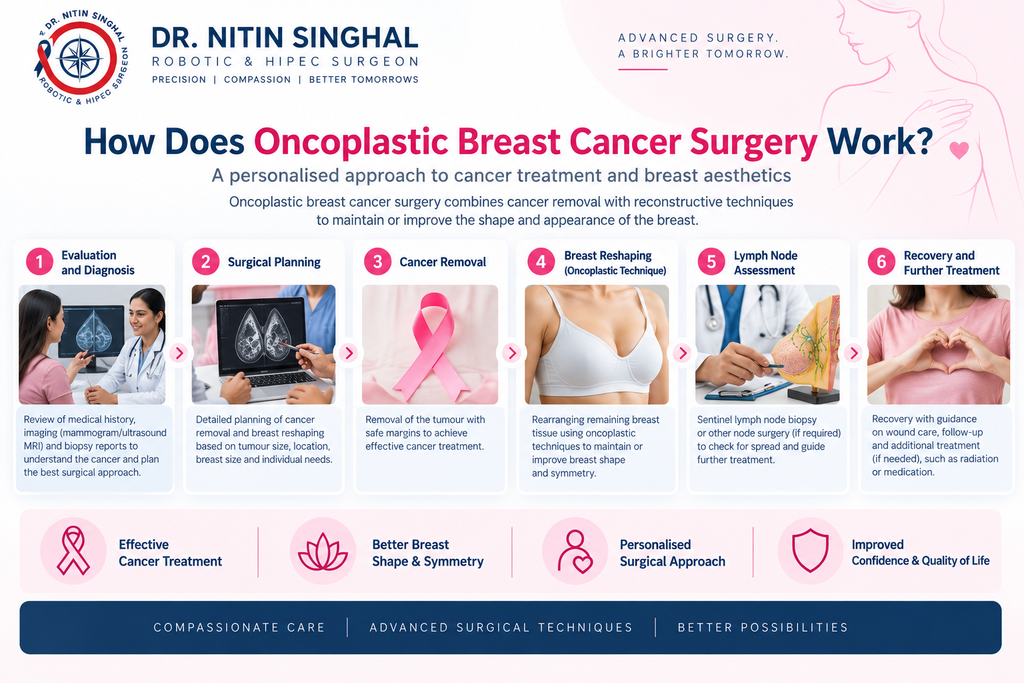
Treatment generally involves several stages.
1. Diagnosis and Evaluation
The surgical team reviews the patient’s:
- Mammogram
- Ultrasound
- Breast MRI when appropriate
- Biopsy report
- Pathology findings
- Hormone-receptor status
- HER2 status
- Clinical stage
- Medical history
2. Treatment Planning
The cancer team determines whether breast-conserving surgery, mastectomy or another approach is appropriate.
3. Surgical Planning
If breast-conserving surgery is possible, the surgeon can plan how the breast will be reshaped after tumour removal.
4. Cancer Removal
The surgeon removes the tumour with an appropriate margin of surrounding tissue.
5. Breast Reshaping
When appropriate, oncoplastic techniques can be used to rearrange breast tissue and improve the breast contour.
6. Lymph-Node Assessment
Depending on the cancer, a sentinel lymph-node biopsy or other lymph-node procedure may be performed.
7. Pathology
The removed tissue is examined by a pathologist to determine whether the tumour has been adequately removed and to provide information that can guide further treatment.
When Is Oncoplastic Breast Surgery Considered?
Oncoplastic surgery may be considered when removal of the tumour is expected to significantly affect breast shape.
It may be particularly useful when:
- A relatively large portion of breast tissue needs to be removed
- The tumour is located in an area where tissue removal could create a visible deformity
- Breast size and shape allow tissue rearrangement
- The patient wants to preserve the breast when medically appropriate
- The surgical team believes an oncoplastic approach is suitable
However, oncoplastic surgery is not appropriate for everyone.
The cancer must first be safely treatable with the proposed surgical approach.
Can Breast Cancer Surgery Preserve the Breast?
In selected patients, yes.
Breast-conserving surgery removes the cancer while preserving much of the breast. Many patients subsequently receive radiation therapy.
Oncoplastic techniques can be incorporated into breast-conserving surgery when appropriate.
The decision depends on the individual cancer rather than simply the patient’s preference for breast preservation.
For example, factors such as tumour size, location, multiple tumours and other clinical considerations may influence whether breast-conserving surgery is appropriate.
What About Breast Reconstruction After Mastectomy?
Patients who undergo mastectomy may have the option of breast reconstruction.
Reconstruction can be performed:
Immediate Reconstruction
Reconstruction begins during the same operation as the mastectomy.
Delayed Reconstruction
Reconstruction is performed later, after the patient has recovered from the initial surgery and, when applicable, completed other cancer treatment.
Reconstruction can involve:
- Breast implants
- Tissue from another part of the patient’s body
- A combination of techniques
The choice depends on the patient’s anatomy, health, cancer treatment, previous surgeries, personal preferences and whether radiation therapy is planned.
What Is Nipple-Sparing Breast Surgery?
In selected patients, a nipple-sparing mastectomy may be an option.
This procedure removes the breast tissue while preserving the skin, nipple and areola when medically appropriate.
However, it is not suitable for every patient. Tumour location, tumour size and involvement of the nipple or surrounding skin are among the factors that may influence eligibility.
If nipple-sparing surgery is being considered, the surgeon should explain both its potential benefits and limitations.
Potential Benefits of Oncoplastic Breast Surgery
When appropriately selected, oncoplastic techniques may offer several potential advantages.
Cancer Treatment and Breast Shape
The approach combines tumour removal with techniques intended to maintain or improve breast contour.
Breast Conservation
Some patients may be able to undergo breast-conserving surgery while addressing the expected change in breast shape.
Reduced Visible Deformity
Tissue rearrangement can sometimes reduce the appearance of dents or contour changes after tumour removal.
Symmetry
In selected cases, surgery may also be performed on the opposite breast to improve symmetry.
Personalised Surgical Planning
The procedure can be planned according to the tumour, breast size, shape and patient’s goals.
Importantly, the primary goal remains safe and appropriate cancer treatment.
Robotic vs Conventional Breast Cancer Surgery
Robotic-assisted and conventional surgery are different surgical approaches.
| Factor | Robotic-Assisted Approach | Conventional Approach |
|---|---|---|
| Surgeon control | Surgeon controls robotic instruments | Surgeon uses conventional instruments |
| Visualisation | Camera-assisted view | Direct or camera-assisted view depending on procedure |
| Surgical access | Depends on procedure | Depends on procedure |
| Suitability | Selected patients/procedures | Broad range of breast procedures |
| Availability | Depends on centre and expertise | Widely available |
| Decision | Based on cancer and patient factors | Based on cancer and patient factors |
Robotic surgery should not be chosen simply because it is technologically advanced. The surgical approach should be based on the cancer and the patient’s individual circumstances.
What Happens Before Breast Cancer Surgery?
Before surgery, your cancer team may perform or review:
- Mammography
- Breast ultrasound
- Breast MRI when required
- Core needle biopsy
- Pathology
- Hormone-receptor testing
- HER2 testing
- Blood tests
- Medical evaluation
- Genetic testing in selected patients
The treatment plan may also involve a multidisciplinary team, which can include a breast surgeon or surgical oncologist, medical oncologist, radiation oncologist, radiologist, pathologist and reconstructive/plastic surgeon.
Breast cancer treatment may involve more than surgery. Depending on the cancer, chemotherapy, hormone therapy, targeted therapy, immunotherapy and/or radiation therapy may also be recommended.
Recovery After Breast Cancer Surgery
Recovery varies depending on the type of operation.
After surgery, patients may experience:
- Pain or tenderness
- Swelling
- Bruising
- Temporary restriction of arm movement
- Fatigue
- Changes in breast sensation
- Scar formation
- Temporary drainage tubes in some procedures
Recovery can take longer when breast reconstruction is performed.
Your surgeon will provide instructions regarding:
- Wound care
- Medication
- Physical activity
- Arm and shoulder exercises
- Follow-up appointments
- Drain care if required
- Radiation or other additional treatment
Possible Risks and Complications
Breast cancer surgery, like any major operation, has potential risks.
These may include:
- Bleeding
- Infection
- Fluid accumulation
- Pain
- Scarring
- Changes in breast sensation
- Changes in breast shape
- Lymphedema after lymph-node surgery
- Problems with wound healing
- Reconstruction-related complications
Mastectomy with reconstruction can involve additional risks, depending on whether implants or tissue flaps are used.
Your surgeon should explain the specific risks associated with your planned procedure.
Who May Be a Candidate for Oncoplastic Breast Surgery?
Oncoplastic surgery may be considered for patients who:
- Have breast cancer requiring surgery
- May benefit from breast-conserving surgery
- Are expected to have a significant change in breast shape after tumour removal
- Have suitable breast anatomy
- Want to discuss breast-conservation or reconstructive options
However, the suitability of oncoplastic surgery is determined individually.
The size, location and extent of the tumour are important considerations.
Why Choose an Experienced Cancer Surgeon?
Breast cancer surgery involves more than removing a tumour.
The surgical team needs to consider:
- Cancer control
- Surgical margins
- Lymph-node assessment
- Breast shape
- Possible radiation therapy
- Reconstruction options
- Recovery
- Long-term follow-up
For patients considering robotic or oncoplastic breast cancer surgery in Ahmedabad, discussing these factors with a surgical oncology specialist can help clarify the available options.
Dr. Nitin Singhal – Robotic & Surgical Oncologist in Ahmedabad
Dr. Nitin Singhal is a Robotic & Surgical Oncologist in Ahmedabad with 18+ years of surgical experience.
His practice focuses on advanced cancer surgery and robotic surgical approaches. Patients can discuss their breast cancer diagnosis, surgical options and whether a robotic or oncoplastic approach may be appropriate for their individual case.
A consultation can help patients understand the relationship between cancer removal, breast conservation, reconstruction and other treatments.
Questions to Ask Your Breast Cancer Surgeon
Before surgery, consider asking:
- What type and stage of breast cancer do I have?
- How large is the tumour?
- Where is the tumour located?
- Can I have breast-conserving surgery?
- Would oncoplastic surgery be appropriate for me?
- Will I need a mastectomy?
- Is nipple-sparing surgery possible?
- Will I need lymph-node surgery?
- Is robotic-assisted surgery appropriate in my case?
- Will I need radiation after surgery?
- Will I need chemotherapy, hormone therapy or targeted treatment?
- What will my breast look like after surgery?
- Should I meet a reconstructive/plastic surgeon before surgery?
- What will my recovery involve?
- Should I get a second opinion?
Robotic & Oncoplastic Breast Cancer Surgery in Ahmedabad
Patients in Ahmedabad and Gujarat have access to a range of breast cancer treatment options, including breast-conserving surgery, mastectomy, reconstruction and oncoplastic techniques.
The appropriate approach depends on the cancer and the patient’s individual circumstances.
If you have recently received a breast cancer diagnosis, bring your available:
- Mammography reports
- Ultrasound reports
- MRI reports
- Biopsy report
- Pathology reports
- Previous treatment records
- Medication list
- Previous surgery reports
These records can help the surgical team understand your diagnosis and discuss appropriate treatment options.
FAQ
What is oncoplastic breast surgery?
Oncoplastic breast surgery combines breast cancer surgery with plastic-surgery techniques to remove the cancer while also addressing breast shape and appearance.
Is oncoplastic surgery the same as breast reconstruction?
Not exactly. Oncoplastic surgery is often performed together with breast-conserving surgery to reshape the remaining breast tissue. Breast reconstruction commonly refers to rebuilding the breast after mastectomy, although reconstructive techniques can be used in several situations.
Can oncoplastic surgery be performed with a lumpectomy?
Yes. Oncoplastic techniques can be performed during breast-conserving surgery in selected patients.
Can breast cancer surgery preserve the breast?
Breast-conserving surgery can preserve much of the breast in appropriately selected patients. Radiation therapy is commonly recommended afterward.
Can reconstruction be performed immediately after mastectomy?
Yes. Breast reconstruction can be performed during the same operation as mastectomy or at a later time.
Is robotic breast cancer surgery suitable for everyone?
No. Robotic-assisted techniques are considered only for selected procedures and patients. The surgeon will determine whether the approach is appropriate based on the cancer and surgical plan.
Does breast reconstruction affect cancer treatment?
Reconstruction is planned alongside cancer treatment. If radiation therapy is expected, it can influence which reconstruction approach and timing are considered.
How long does recovery take?
Recovery varies depending on whether you have lumpectomy, mastectomy, lymph-node surgery, reconstruction or a combination of procedures.
Can I get a second opinion before breast cancer surgery?
Yes. A second opinion can help you understand your diagnosis, treatment options and possible surgical approaches before making a treatment decision.
Conclusion
Robotic and oncoplastic breast cancer surgery represents a modern approach that considers both cancer treatment and surgical outcomes.
Oncoplastic techniques can combine tumour removal with breast-reshaping techniques in selected patients, while reconstruction can restore breast shape after mastectomy.
Robotic-assisted techniques may also have a role in selected breast procedures, but they are not suitable or necessary for every patient.
The most appropriate treatment depends on the type and stage of breast cancer, tumour location and size, lymph-node status, overall health, treatment plan and individual preferences.
If you have been diagnosed with breast cancer in Ahmedabad or Gujarat, discussing your options with a qualified surgical oncology team can help you understand whether breast-conserving, oncoplastic, reconstructive or robotic-assisted surgery may be appropriate for you.
Book a Consultation
Discuss your breast cancer diagnosis, surgical options and personalised treatment plan with Dr. Nitin Singhal in Ahmedabad.
This article is for general educational purposes only and does not replace an examination, diagnosis or personalised medical advice from a qualified healthcare professional.