
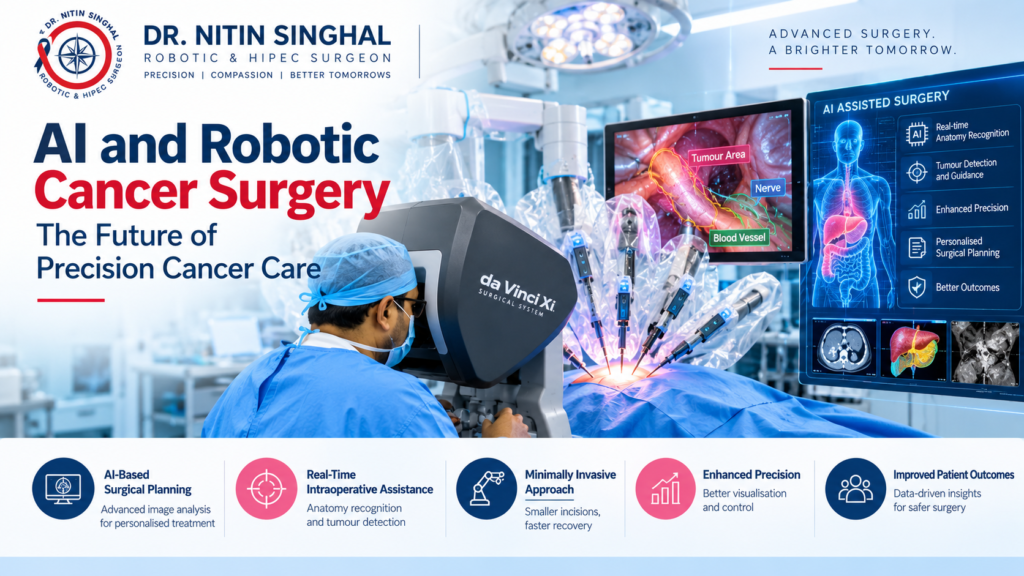
Cancer surgery is entering a new technological era.
Robotic surgical platforms have already changed how surgeons approach selected complex procedures by providing enhanced visualisation, instrument flexibility and precise surgeon-controlled movements. Now, artificial intelligence (AI) is becoming an important area of research in robotic surgery.
Researchers are exploring how AI can assist surgeons before, during and after cancer operations—from analysing medical images and helping with surgical planning to recognising anatomy and providing intraoperative guidance.
Recent 2026 reviews describe this development as a transition from conventional robot assistance toward increasingly data-driven and AI-assisted surgery.
But there is an important distinction:
AI-assisted robotic surgery does not mean that a robot independently performs cancer surgery.
The surgeon remains responsible for clinical decisions and control of the procedure in currently established assistive applications. Fully autonomous surgery involving complex soft tissues remains an area of ongoing research.
What Is AI-Assisted Robotic Cancer Surgery?
AI-assisted robotic cancer surgery refers to the use of artificial intelligence and machine-learning technologies alongside robotic surgical systems.
AI may potentially help analyse:
- Medical images
- Surgical video
- Anatomical structures
- Surgical movements
- Tumour-related information
- Intraoperative events
- Post-operative data
The goal is not simply to make surgery more automated.
Instead, researchers are investigating whether AI can help surgeons see more information, recognise patterns, plan procedures and make better-informed decisions.
A 2026 review in Nature Reviews Urology identifies areas such as anatomy recognition, error detection, augmented navigation, surgical skill assessment and intraoperative assistance as important directions for AI-enabled robotic surgery.
How Is AI Changing Robotic Cancer Surgery?
AI is being explored across several stages of the surgical journey.
1. Pre-Operative Surgical Planning
Before surgery, doctors may need to evaluate CT scans, MRI scans, PET imaging and other diagnostic information.
AI-based systems can analyse medical images and potentially identify patterns or anatomical structures that may assist treatment planning.
Researchers are also studying how AI can combine imaging and other patient information to support personalised surgical planning.
However, these technologies should currently be regarded as decision-support tools rather than replacements for specialist clinical judgement.
2. Three-Dimensional Surgical Planning
Complex cancer operations often involve anatomy that is difficult to understand from conventional two-dimensional images.
AI and computer-assisted technologies can potentially help convert imaging information into:
- 3D anatomical models
- Tumour-location maps
- Patient-specific surgical simulations
- Virtual surgical planning
This area is also connected to the emerging concept of the digital twin, where researchers explore patient-specific virtual models that could support simulation and robotic surgery.
A 2026 analysis of digital-twin-enabled robotic surgery identified rapid growth in research combining patient-specific simulation, AI, robotics, extended reality and surgical autonomy.
3. Real-Time Anatomy Recognition
During surgery, surgeons must constantly identify anatomical structures.
AI-based computer vision systems are being studied to recognise structures in surgical video.
Potential applications include identifying:
- Blood vessels
- Organs
- Tissue planes
- Anatomical landmarks
- Tumour-related structures
This could provide additional information to the surgeon during an operation.
However, research still needs rigorous clinical validation before many such systems become routine clinical tools.
4. AI-Assisted Tumour and Tissue Identification
One of the most interesting areas of research is whether AI can help distinguish tumour tissue from surrounding normal tissue.
Researchers are investigating technologies such as:
- Computer vision
- Image analysis
- Optical imaging
- Augmented reality
- Image registration
- Machine learning
The objective is to provide the surgeon with additional information while operating.
In surgical oncology, recent research has described AI-assisted approaches for real-time visualisation of tumour margins and functional boundaries.
However, these technologies should not be presented as a guarantee of complete tumour removal. Clinical validation remains essential.
5. AI During Robotic Surgery
Modern robotic systems generate large amounts of information from:
- Surgical video
- Instrument movement
- Camera position
- Surgical actions
- Procedure timing
AI can potentially analyse this information.
Researchers are studying whether such data can help with:
- Surgical navigation
- Error detection
- Risk prediction
- Performance assessment
- Surgical training
- Procedure standardisation
A 2026 review reported that AI-assisted systems are being investigated for real-time assistance, anatomy recognition, risk anticipation and feedback while keeping the surgeon in control.
6. AI and Surgical Skill Assessment
Another emerging application is AI-based assessment of surgical technique.
Traditionally, surgical skills may be assessed by experienced surgeons observing procedures.
AI can potentially analyse surgical video and robotic movement data to provide more objective measurements.
Researchers are investigating:
- Instrument movements
- Procedure efficiency
- Surgical errors
- Tissue handling
- Technical performance
- Learning curves
This could eventually contribute to surgical education and training.
7. AI After Cancer Surgery
AI is not limited to the operating room.
Researchers are also studying its use after surgery for:
- Predicting complications
- Analysing recovery
- Risk stratification
- Monitoring outcomes
- Supporting follow-up planning
A recent review of AI in surgical oncology describes applications across the preoperative, intraoperative and postoperative stages of care.
Does AI Perform Robotic Cancer Surgery by Itself?
This is one of the most important questions patients ask.
Currently, the answer is generally no for complex cancer surgery.
In established robotic-assisted procedures, the surgeon controls the robotic system.
AI research is increasingly focused on assistive functions such as:
- Recognising anatomy
- Providing navigation
- Analysing images
- Detecting potential errors
- Offering decision support
- Assessing surgical performance
Fully autonomous surgery involving complex soft tissues remains an early research area. A 2026 review specifically notes that autonomous systems in soft-tissue surgery remain largely at the experimental or preclinical stage.
Therefore, headlines suggesting that AI robots are already independently performing complex cancer operations should be interpreted carefully.
What Are the Potential Advantages of AI-Assisted Robotic Surgery?
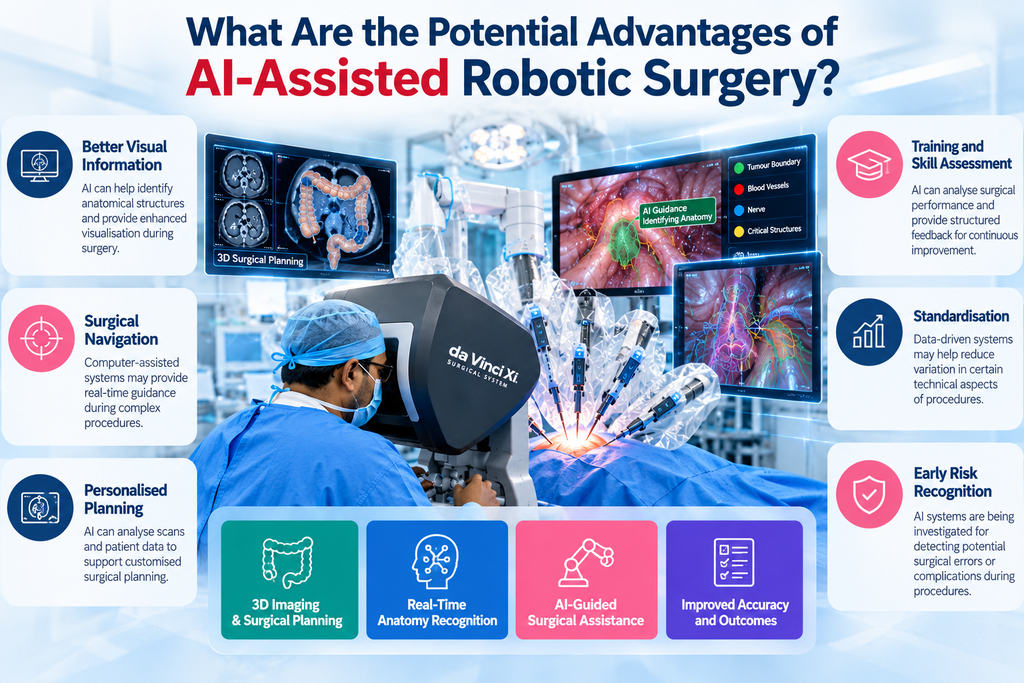
If successfully validated and implemented, AI-assisted robotic technologies could potentially help with:
Better Visual Information
AI may help identify anatomical structures or patterns that are difficult to recognise.
Surgical Navigation
Computer-assisted systems may provide additional guidance during complex procedures.
Personalised Planning
Patient-specific imaging and data could potentially contribute to customised surgical planning.
Training and Skill Assessment
AI can analyse surgical performance and provide structured feedback.
Standardisation
Data-driven systems may help reduce variation in certain technical aspects of procedures.
Early Risk Recognition
AI systems are being investigated for detecting potential surgical errors or complications during procedures.
These are potential applications, not universal benefits guaranteed to every patient.
What Are the Limitations of AI in Robotic Cancer Surgery?
AI-assisted surgery also has significant challenges.
Data Quality
AI systems require large, high-quality datasets.
If the training data are incomplete or unrepresentative, system performance may vary.
Clinical Validation
A technology that performs well in a laboratory or retrospective study still needs appropriate clinical testing.
Different Patients and Hospitals
An AI model developed using data from one hospital may not perform identically in another environment.
Accountability
Doctors and healthcare institutions need clear responsibility for clinical decisions when AI tools are involved.
Privacy
Surgical videos, medical images and patient records contain sensitive health information and require appropriate data governance.
Cost and Accessibility
Advanced robotic and AI technologies may require significant infrastructure and specialist training.
A 2026 expert consensus on AI-enhanced surgical practice emphasised the need for rigorous evaluation, governance, real-world evidence and ongoing oversight before broad implementation.
AI Does Not Replace the Cancer Surgeon
Technology can provide information, but cancer surgery requires clinical judgement.
A surgeon must consider:
- Cancer biology
- Tumour stage
- Anatomy
- Previous treatments
- Patient health
- Surgical risks
- Functional outcomes
- Pathology
- Other treatment options
The decision to perform surgery—and the choice of surgical technique—cannot be reduced to an algorithm.
The emerging model is therefore better described as:
Human surgical expertise + robotic technology + AI-assisted information
rather than:
AI replacing the surgeon.
Recent literature similarly describes the future of surgical AI as a relationship between human expertise and technological assistance.
What Could the Future of Robotic Cancer Surgery Look Like?
The next generation of robotic cancer surgery may involve increasingly connected technologies.
These could include:
AI Surgical Copilots
AI systems that provide information or assistance during procedures.
Augmented Reality
Digital information overlaid onto the surgeon’s view.
Patient-Specific Digital Twins
Virtual models that may allow surgeons to simulate aspects of a procedure before operating.
Advanced Image Guidance
Integration of CT, MRI, PET or other imaging information into surgical navigation.
Surgical Video Intelligence
AI analysis of surgical video to recognise anatomy, procedural steps and potential events.
Remote Collaboration
Robotic and telepresence technologies may eventually support collaboration between specialists in different locations, although regulatory, technical and clinical considerations remain important.
These technologies are developing at different speeds, and many remain under investigation.
Which Cancers Can Be Treated With Robotic Surgery?
Robotic surgery is already used in selected procedures across several areas of surgical oncology.
Depending on the cancer and patient, robotic approaches may be considered in areas such as:
- Gastrointestinal cancers
- Colorectal cancers
- Urological cancers
- Gynecologic cancers
- Thoracic cancers
- Selected head and neck cancers
- Other complex surgical procedures
The availability and suitability of robotic surgery vary by tumour type, stage, anatomy and surgical expertise.
Robotic surgery is not automatically appropriate for every cancer.
Is Robotic Cancer Surgery Available in Ahmedabad?
Robotic cancer surgery is an area of specialised surgical oncology in India, including Ahmedabad.
For patients considering robotic cancer surgery, an important first step is understanding whether the technique is appropriate for their specific cancer and stage.
Dr. Nitin Singhal is a Robotic & Surgical Oncologist in Ahmedabad with 18+ years of surgical experience, focusing on advanced cancer surgery and robotic surgical approaches.
Patients can discuss their diagnosis, available surgical options and whether a robotic approach may be appropriate for their individual case.
Questions to Ask About AI and Robotic Cancer Surgery
If your surgeon recommends robotic surgery, consider asking:
- Is robotic surgery appropriate for my cancer?
- Why is this approach being recommended?
- Is AI-assisted technology being used during my procedure?
- What exactly does the technology do?
- Does the surgeon remain in control?
- What are the alternatives to robotic surgery?
- What are the risks and benefits?
- How experienced is the surgical team with this procedure?
- What should I expect during recovery?
- Will I need chemotherapy or radiation after surgery?
FAQ | AI and Robotic Cancer Surgery
Is AI currently replacing cancer surgeons?
No. Current AI-assisted surgical systems are primarily being developed as tools that assist surgeons with visualisation, planning, navigation, analysis and other tasks. Complex autonomous soft-tissue surgery remains an emerging research area.
Does robotic surgery mean the robot operates independently?
No. In conventional robotic-assisted surgery, the surgeon controls the robotic system.
Can AI detect cancer during surgery?
Researchers are investigating AI-assisted image analysis and intraoperative guidance, but the reliability and clinical use of individual technologies vary. AI should not be presented as a replacement for pathology or specialist clinical judgement.
Is robotic cancer surgery safer than traditional surgery?
Safety depends on the specific operation, patient and surgical team. Robotic technology may offer technical advantages in selected procedures, but it does not automatically make every cancer operation safer.
Is AI-assisted robotic surgery available for every cancer?
No. Availability and suitability depend on the cancer type, location, stage, surgical procedure, technology and clinical expertise.
Will robotic surgery become fully autonomous?
Autonomous surgery is an active area of research, but complex soft-tissue cancer surgery remains far from routine autonomous operation. Current research emphasises gradual development with human oversight.
Conclusion
The combination of robotic surgery, artificial intelligence, advanced imaging and surgical data science is becoming one of the most closely watched developments in modern surgical oncology.
AI may increasingly help surgeons with pre-operative planning, anatomy recognition, image guidance, surgical analysis, risk detection and performance assessment.
At the same time, it is important to distinguish today’s clinical reality from future possibilities. AI-assisted surgery is developing rapidly, but complex autonomous cancer surgery remains an emerging research field.
For patients, the most important question is not simply whether a hospital has robotic or AI technology. It is whether the proposed technology is appropriate for their specific cancer and being used by an appropriately trained surgical team.
For patients in Ahmedabad considering robotic cancer surgery, consultation with a surgical oncology specialist can help clarify the diagnosis, available treatment approaches and whether robotic surgery may be suitable.
Medical Disclaimer: This article is for general educational purposes and does not replace personalised medical advice, diagnosis or treatment. Surgical decisions should be made with your treating cancer team.