

A diagnosis of gynecologic cancer can be overwhelming. Along with understanding the cancer itself, patients and families often have questions about surgery, recovery, treatment options, and whether minimally invasive techniques may be suitable.
Advances in surgical technology have introduced robotic-assisted surgery as an option for selected patients with gynecologic cancers. Robotic surgery allows a trained surgeon to operate through small incisions using a specialized robotic platform that provides magnified, high-definition visualization and precise instrument control.
However, robotic surgery is not automatically the best choice for every patient. The appropriate surgical approach depends on the type and stage of cancer, tumour location, anatomy, previous treatments, overall health, and the surgeon’s assessment.
For patients considering treatment in Gujarat, understanding robotic gynecologic cancer surgery in Ahmedabad can help them have a more informed discussion with their cancer surgeon.
What Is Robotic Gynecologic Cancer Surgery?
Robotic gynecologic cancer surgery is a minimally invasive surgical approach used in selected cases of cancer affecting the female reproductive system.
The robotic platform does not independently perform the operation. The surgeon controls the instruments from a console and guides every surgical movement in real time.
The system can provide:
- Magnified, high-definition 3D visualization
- Precise movement of surgical instruments
- Greater instrument articulation in confined spaces
- Small surgical incisions
- Improved access to certain areas of the pelvis
These features can be useful when performing technically demanding pelvic procedures.
The goal is not simply to use advanced technology. The goal is to select the surgical approach that can safely and effectively treat the cancer while considering the patient’s recovery and quality of life.
Which Gynecologic Cancers May Be Considered for Robotic Surgery?
Robotic surgery may be considered for selected patients with certain gynecologic cancers.
Depending on the diagnosis and stage, this can include:
Uterine or endometrial cancer develops in the lining or other tissues of the uterus.
For selected patients, minimally invasive surgery may be considered for removal of the uterus and other structures or lymph nodes when clinically appropriate.
Cervical cancer develops in the cervix, the lower part of the uterus.
Treatment depends significantly on the stage and characteristics of the cancer. Surgery may be appropriate for selected early-stage cases, while other patients may require radiation, chemotherapy, or combined treatment.
The surgical approach should be decided after proper staging and evaluation.
Ovarian cancer requires careful assessment because it can spread within the abdomen and pelvis.
Surgery for ovarian cancer may involve more extensive procedures depending on the stage and spread of disease. Robotic surgery may be considered in selected situations, but it is not appropriate for every ovarian cancer patient.
Other Gynecologic Malignancies
Some other cancers affecting the female reproductive system may also require surgery as part of treatment.
Because each cancer behaves differently, treatment should be individualized rather than choosing robotic surgery simply because it is available.
How Does Robotic Gynecologic Cancer Surgery Work?
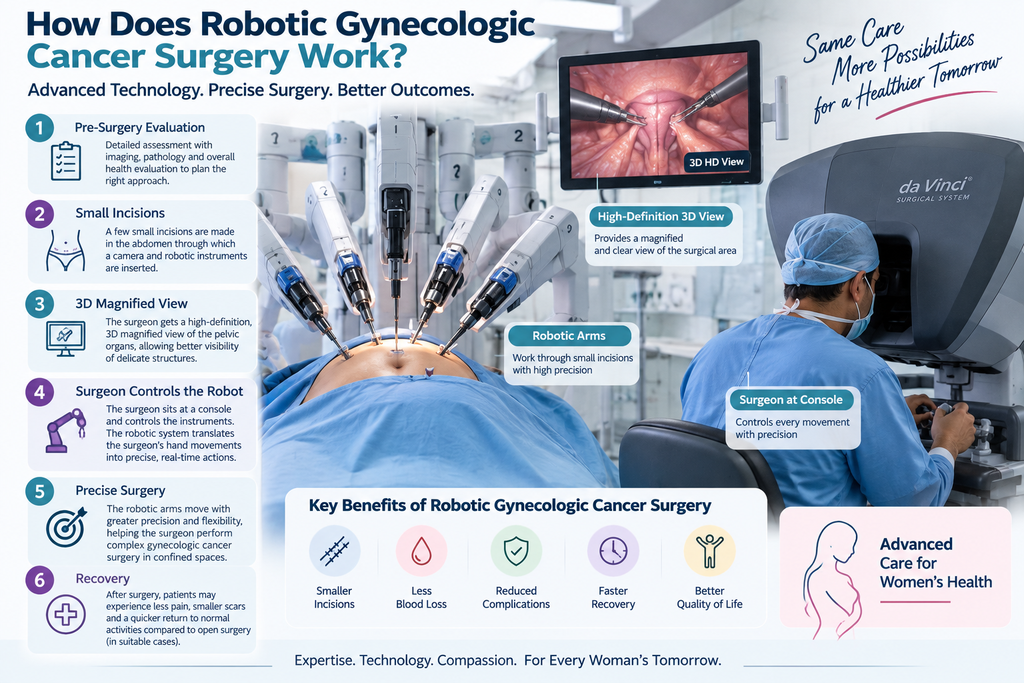
During robotic-assisted surgery, the patient is placed under general anesthesia.
The surgeon makes several small incisions through which specialized instruments and a camera are introduced.
The surgeon then operates using a robotic console.
The robotic system can translate the surgeon’s hand movements into controlled movements of the instruments inside the body.
One important advantage is the combination of magnified visualization and precise instrument movement, which can be particularly useful during surgery in the confined pelvic region.
The surgeon remains responsible for planning and performing the procedure throughout the operation.
What Are the Potential Benefits of Robotic Surgery?
When robotic surgery is appropriate for a particular patient, the minimally invasive approach may offer several potential advantages compared with some open procedures.
Smaller Incisions
Robotic procedures generally use several small incisions rather than one large abdominal incision.
This may result in smaller scars.
Less Surgical Trauma
Smaller access points can reduce the amount of tissue disruption associated with the surgical approach.
Potentially Less Blood Loss
In selected procedures, the precision and visualization offered by robotic surgery may help surgeons perform delicate surgical steps with controlled movements.
Reduced Postoperative Discomfort
Patients undergoing minimally invasive surgery may experience less postoperative discomfort compared with some open procedures, although pain varies from person to person.
Earlier Mobility
Smaller incisions and potentially less postoperative discomfort may help some patients become mobile sooner after surgery.
Shorter Hospital Stay
Some patients may be able to leave the hospital sooner following minimally invasive surgery, depending on the procedure, their recovery, and overall health.
Faster Return to Routine Activities
Recovery varies considerably, but minimally invasive surgery can allow some appropriately selected patients to return to normal activities sooner than they might after a major open operation.
These benefits should be discussed in the context of the specific cancer and procedure. Robotic surgery does not guarantee a faster recovery or better cancer outcome for every patient.
Is Robotic Surgery Better Than Open Surgery for Gynecologic Cancer?
There is no single surgical technique that is best for every cancer patient.
Open, laparoscopic, and robotic approaches each have a role in cancer surgery.
The choice may depend on:
- Type of cancer
- Cancer stage
- Tumour size
- Tumour location
- Whether the cancer has spread
- Previous abdominal or pelvic surgery
- Patient’s overall health
- Surgical complexity
- Experience of the surgical team
- Available hospital infrastructure
For some patients, robotic surgery may offer the advantages of minimally invasive surgery.
For others, open surgery may be more appropriate, particularly when extensive tumour removal or complex procedures are required.
The most important consideration is safe and appropriate cancer treatment, not the use of technology for its own sake.
Is Robotic Gynecologic Cancer Surgery Safe?
Robotic surgery is performed under the control of a trained surgeon using a specialized surgical platform.
Like every major operation, robotic cancer surgery has potential risks.
Depending on the procedure, these may include:
- Bleeding
- Infection
- Blood clots
- Injury to nearby organs
- Anesthesia-related complications
- Urinary or bowel complications
- Need to convert to open surgery
- Cancer-specific complications
The actual risks depend on the patient’s health, the cancer, the extent of surgery, and the procedure being performed.
Before surgery, your surgeon should explain the expected benefits, alternatives, possible complications, and recovery process.
How Is a Patient Evaluated Before Robotic Cancer Surgery?
Robotic surgery should begin with careful cancer assessment.
Before recommending surgery, the cancer team may review:
Pathology
A biopsy or pathology report helps establish the type and characteristics of the cancer.
Imaging
Depending on the cancer, investigations may include CT, MRI, PET-CT, ultrasound, or other imaging studies.
Cancer Stage
Staging helps determine how advanced the cancer is and whether surgery is appropriate.
Medical History
Previous operations, medical conditions, medications, allergies, and previous cancer treatments can influence surgical planning.
Overall Fitness
The patient’s general health and ability to undergo anesthesia and surgery are important considerations.
Multidisciplinary Evaluation
Cancer treatment may involve surgical oncology, medical oncology, radiation oncology, radiology, pathology, and other specialists.
A treatment plan may therefore involve surgery alone or surgery combined with chemotherapy, radiation therapy, targeted therapy, immunotherapy, or other treatments depending on the cancer.
What Should You Ask a Robotic Cancer Surgeon?
If robotic gynecologic cancer surgery has been recommended, prepare questions before your consultation.
You may ask:
About Your Cancer
- What type of gynecologic cancer do I have?
- What is the stage of my cancer?
- Has the cancer spread?
- What is the goal of surgery?
About Robotic Surgery
- Am I a suitable candidate for robotic surgery?
- Why is robotic surgery being recommended in my case?
- What procedure will be performed?
- What are the alternatives?
- Would open or laparoscopic surgery be more appropriate?
About Recovery
- How long might I stay in the hospital?
- When can I walk normally?
- When can I return to work?
- What activities should I avoid during recovery?
About Cancer Treatment
- Will I need chemotherapy or radiation?
- Will additional treatment be required after surgery?
- How will my cancer be monitored after treatment?
Asking these questions can help you understand the reasoning behind your treatment plan.
What Is Recovery Like After Robotic Gynecologic Cancer Surgery?
Recovery depends on the type and complexity of the operation.
Some patients recover relatively quickly after minimally invasive surgery, while more extensive cancer operations may require a longer recovery period.
After surgery, the medical team will monitor:
- Pain control
- Wound healing
- Urination and bowel function
- Ability to walk
- Nutrition and hydration
- Signs of infection
- Other procedure-specific concerns
Your surgeon will provide individualized instructions regarding physical activity, medications, diet, wound care, and follow-up appointments.
It is important not to compare your recovery directly with another patient’s experience.
Will Robotic Surgery Remove the Cancer Completely?
The objective of cancer surgery is to remove the cancer safely and achieve appropriate cancer control.
However, no surgical technique can guarantee that cancer will never return.
The outcome depends on many factors, including:
- Cancer type
- Stage
- Tumour biology
- Extent of disease
- Response to other treatments
- Completeness of tumour removal
- Overall health
Robotic technology is a surgical tool. It does not independently cure cancer.
The surgeon’s expertise, appropriate patient selection, cancer staging, treatment planning, and multidisciplinary care remain essential.
Why Surgeon Experience Matters in Robotic Cancer Surgery
Robotic surgery is technology-assisted surgery, but the surgeon remains central to every major decision.
When considering a robotic cancer surgeon, patients may want to understand:
- The surgeon’s oncology training
- Experience with the relevant cancer
- Experience with robotic procedures
- Hospital infrastructure
- Availability of multidisciplinary cancer care
- Approach to patient communication
- Follow-up and postoperative care
Dr. Nitin Singhal is a surgical oncologist with expertise in robotic and HIPEC surgery and experience managing gynecological malignancies. His website states that he has trained at Tata Memorial Centre and specializes in complex oncological procedures, including robotic surgery.
His practice also describes robotic surgery as part of a broader cancer-care approach that includes gastrointestinal, gynecological, urological, and other malignancies.
Why Consider Robotic Gynecologic Cancer Surgery in Ahmedabad?
Ahmedabad has established hospitals and cancer-care centres where patients can access surgical oncology and advanced minimally invasive procedures.
For a patient considering robotic gynecologic cancer surgery, it is important to look beyond the technology itself.
Consider:
- The surgeon’s cancer-specific experience
- The hospital’s surgical infrastructure
- Availability of robotic technology
- Anesthesia and intensive-care support
- Pathology and imaging facilities
- Medical and radiation oncology support
- Postoperative monitoring
- Follow-up care
A comprehensive cancer-care environment can be particularly important when managing complex malignancies.
Robotic Surgery Is Not Right for Every Patient
One of the most important things patients should understand is that robotic surgery is not automatically superior for every cancer patient.
A surgeon may recommend open surgery if the tumour is extensive, the cancer has spread significantly, or the operation requires an approach that cannot safely be performed robotically.
Similarly, minimally invasive surgery may be appropriate for one patient but not another with the same general type of cancer.
The decision should always be based on the individual clinical situation.
When Should You Seek a Second Opinion?
If you have been advised to undergo major cancer surgery and are uncertain about the recommended approach, seeking a second opinion can help you understand your options.
You may want to seek another opinion if:
- You are unsure about the diagnosis
- You have questions about the cancer stage
- You have been advised to undergo extensive surgery
- You want to understand whether robotic surgery is appropriate
- You have been offered multiple treatment options
- You want another specialist to review your imaging or pathology
A second opinion does not necessarily mean that the first treatment recommendation is incorrect. It can provide additional information and confidence before making an important decision.
Choosing a Robotic Gynecologic Cancer Surgeon in Ahmedabad
Choosing a surgeon is an important part of cancer treatment.
Rather than selecting a surgeon based only on claims such as “best” or “advanced,” consider whether the surgeon has appropriate oncology training and experience with the type of cancer and procedure being considered.
You can also ask about:
- Qualifications
- Cancer surgery experience
- Robotic surgery experience
- Hospital affiliations
- Surgical approach
- Expected recovery
- Potential risks
- Alternative treatments
- Postoperative follow-up
A good consultation should give you enough information to understand why a particular treatment is being recommended.
Take the Next Step in Your Cancer Care
A diagnosis of gynecologic cancer can be difficult to process, but understanding your treatment options can help you make informed decisions.
Robotic gynecologic cancer surgery may be an option for selected patients, but suitability depends on the cancer type, stage, anatomy, overall health, and the surgical assessment.
If you are looking for a robotic gynecologic cancer surgeon in Ahmedabad, you can consult Dr. Nitin Singhal to discuss your diagnosis, surgical options, and whether a robotic approach may be appropriate for your individual case.
Bring your pathology reports, scans, previous treatment records, and other relevant medical documents to your consultation.
Book a Consultation
If you have been diagnosed with gynecologic cancer or have been advised to undergo cancer surgery, discussing your case with a surgical oncologist can help you understand the next steps.
Contact Dr. Nitin Singhal for a personalized consultation regarding robotic gynecologic cancer surgery in Ahmedabad.
FAQ | Robotic Gynecologic Cancer Surgery in Ahmedabad
What is robotic gynecologic cancer surgery?
Robotic gynecologic cancer surgery is a minimally invasive surgical approach in which a trained surgeon controls specialized robotic instruments to perform selected cancer procedures through small incisions.
Which gynecologic cancers can be treated with robotic surgery?
Robotic surgery may be considered for selected cases of uterine, cervical, ovarian, and other gynecologic malignancies. Suitability depends on cancer type, stage, tumour characteristics, and the patient’s overall condition.
Is robotic surgery suitable for every gynecologic cancer patient?
No. Robotic surgery is not appropriate for every patient. The surgical approach should be selected after evaluating the cancer stage, tumour location, anatomy, previous treatments, overall health, and complexity of the operation.
Is robotic cancer surgery better than open surgery?
Not necessarily. Robotic surgery can provide minimally invasive advantages in appropriately selected patients, but open surgery may be more suitable for certain complex or advanced cancers.
How long does recovery take after robotic gynecologic cancer surgery?
Recovery varies according to the type and extent of surgery and the patient’s overall health. Your surgeon can provide a more accurate recovery estimate after evaluating your individual case.
Is robotic surgery painful?
Some postoperative discomfort is expected after any surgery. Minimally invasive robotic procedures may result in less postoperative discomfort for some patients compared with certain open procedures, but individual experiences vary.
Does robotic surgery cure gynecologic cancer?
Robotic surgery is a surgical technique, not an independent cure for cancer. The outcome depends on cancer type, stage, tumour biology, completeness of treatment, and other factors.
How do I know if I am a candidate for robotic gynecologic cancer surgery?
A surgical oncologist needs to review your diagnosis, pathology, imaging, cancer stage, medical history, and overall health before determining whether robotic surgery is appropriate.
Medical Disclaimer: This article is intended for general patient education and should not be considered a substitute for an individual medical consultation. Cancer treatment decisions should be made with a qualified cancer specialist after reviewing the patient’s diagnosis, pathology, imaging, stage, and overall health.