
When is thyroid surgery needed?
Your doctor may recommend surgery if you have:
- Thyroid cancer, or a nodule that is suspicious on biopsy (FNAC)
- A large goitre pressing on the windpipe or food pipe
- Nodules that keep growing
- Some cases of overactive thyroid that do not respond to medicines
The operation may remove half the thyroid (hemithyroidectomy) or the whole gland (total thyroidectomy), depending on the diagnosis.
How does robotic thyroid surgery work?
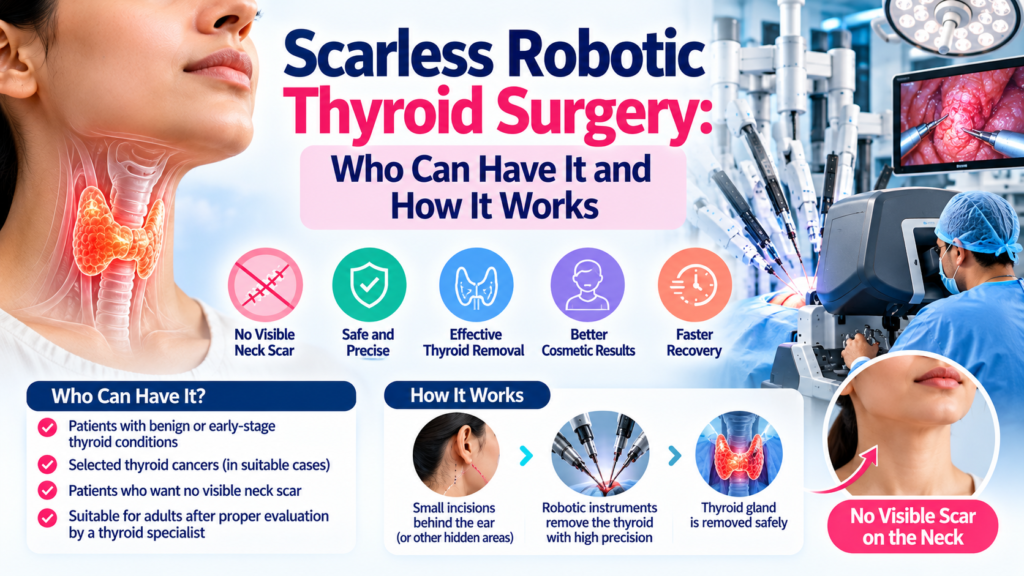
Instead of a cut on the neck, the surgeon makes small incisions in a hidden area. Common approaches use the armpit, the area around the breast, behind the ear, or inside the lower lip. Thin robotic instruments are passed under the skin to reach the thyroid.
The robot gives the surgeon a magnified 3D view, which helps protect two important structures near the thyroid:
- The recurrent laryngeal nerves, which control the voice
- The parathyroid glands, which control calcium levels in the blood
Who is suitable?
Robotic thyroid surgery is usually considered for:
- Small to medium thyroid nodules
- Early, well-differentiated thyroid cancer without major spread
- Patients who strongly want to avoid a neck scar
It may not be suitable for very large goitres, cancers that have spread into nearby structures, or patients who have had previous neck surgery or radiation. Your surgeon will decide after examining you and reviewing your ultrasound and biopsy reports.
Benefits and limitations
| Conventional thyroid surgery | Robotic thyroid surgery | |
|---|---|---|
| Scar | On the front of the neck | Hidden; none on the front of the neck |
| Operating time | Shorter | Longer |
| Cost | Lower | Higher |
| Hospital stay | Short | Short |
| Cancer control in suitable patients | Standard | Comparable in experienced hands |
The main benefit is cosmetic: no visible neck scar. The operation itself is longer and costs more. For more on choosing between approaches, see robotic vs laparoscopic vs open cancer surgery.
Risks
All thyroid operations carry some risks, whichever approach is used:
- Temporary or, rarely, permanent change in voice
- Low calcium levels for some days or weeks (tingling in the fingers or around the mouth)
- Bleeding or a collection of fluid
- Numbness or discomfort along the tunnel used for the instruments
Recovery
- Most patients go home in 1–2 days.
- If the whole thyroid is removed, you will need a daily thyroid hormone tablet for life.
- Calcium tablets may be needed for a short time.
- Some patients with cancer need radioactive iodine treatment after surgery.
- Most people return to office work within 1–2 weeks.
Frequently asked questions
Is robotic thyroid surgery truly scarless? There are small scars, but they are hidden in the armpit, hairline, breast area or inside the mouth, so nothing is visible on the front of the neck.
Is it safe for thyroid cancer? For carefully selected early cancers, results are comparable to conventional surgery when done by an experienced surgeon.
Will my voice change? Most patients have no lasting voice change. Temporary hoarseness can occur and usually improves.
Consult a robotic thyroid surgeon in Ahmedabad
Dr. Nitin Singhal performs conventional and robotic thyroid surgery as part of his head and neck cancer surgery practice. Bring your ultrasound and FNAC reports to discuss whether scarless surgery is right for you. Book a consultation or call +91 75061 14222. You may also want to read about mouth and throat cancer and TORS.