
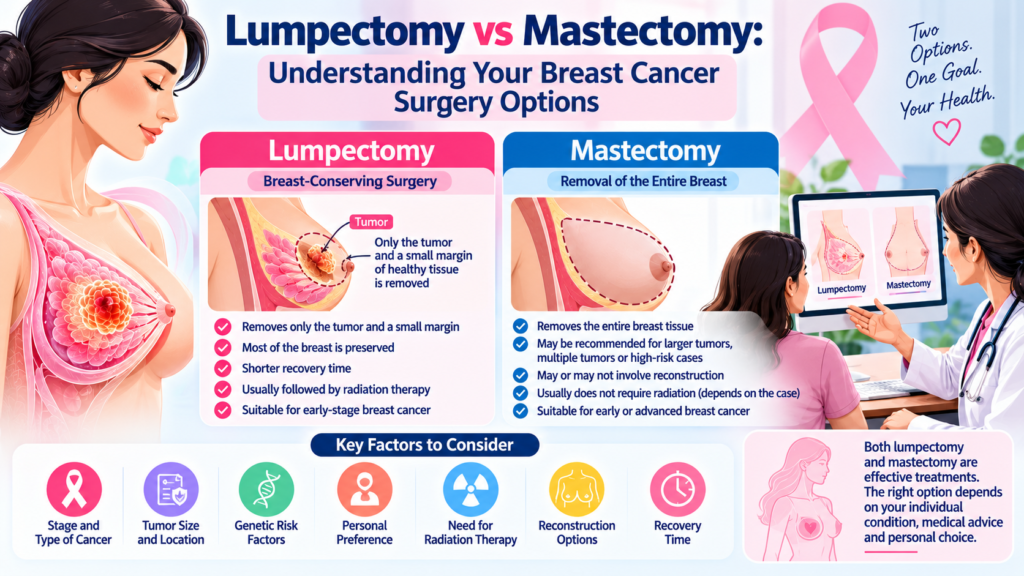
What is a lumpectomy (breast-conserving surgery)?
The surgeon removes the cancer with a margin of normal tissue and keeps the rest of the breast. It is almost always followed by radiation therapy to the breast to lower the chance of the cancer returning.
Usually suitable when:
- The tumour is small compared with the size of the breast
- There is one main area of cancer
- Radiation therapy is possible and the patient can attend it
Sometimes chemotherapy is given before surgery to shrink a larger tumour, so that the breast can be saved.
What is a mastectomy?
The whole breast is removed. Types include:
- Total mastectomy: removal of the breast tissue
- Modified radical mastectomy: breast plus lymph nodes in the armpit
- Skin-sparing or nipple-sparing mastectomy: keeps the skin envelope, usually with reconstruction
Usually recommended when:
- The tumour is large compared with the breast
- Cancer is present in several areas of the breast
- Radiation cannot be given, for example due to previous radiation to the chest
- The patient carries a high-risk gene such as BRCA, or prefers mastectomy after discussion
Side-by-side comparison
| Lumpectomy + radiation | Mastectomy | |
|---|---|---|
| Breast kept | Yes | No (reconstruction possible) |
| Radiation needed | Almost always | Sometimes |
| Hospital stay | Short | Slightly longer |
| Survival in early breast cancer | Similar | Similar |
| Chance of needing another operation for margins | Higher | Lower |
What about the lymph nodes?
Cancer can spread to the lymph nodes in the armpit. Many women now have a sentinel lymph node biopsy, where only the first one to three nodes are removed and tested. If they are clear, the rest of the nodes can usually be left alone, lowering the risk of arm swelling (lymphoedema). If the nodes contain cancer, more nodes may need to be removed.
Breast reconstruction
Women who have a mastectomy can discuss reconstruction, either at the same operation or later. It can be done with implants or with the patient’s own tissue. Oncoplastic techniques can also improve the shape of the breast after a lumpectomy.
How to choose
The decision depends on the tumour size, type, location, gene status, breast size and, importantly, your own preferences. Ask your surgeon:
- Am I a candidate for breast-conserving surgery?
- Would chemotherapy before surgery help save the breast?
- Will I need radiation either way?
- Is reconstruction an option for me?
Recovery
- Most women go home within 1–2 days after a lumpectomy and a few days after a mastectomy.
- Arm exercises start early to keep the shoulder moving.
- A drain may be left for some days.
- Support from family and other survivors helps a great deal. See our general recovery guide after cancer surgery.
Know the warning signs
A painless lump, a change in breast shape, skin dimpling, nipple discharge or an inward-turning nipple should be checked without delay. Women with a family history of breast or ovarian cancer should ask about genetic counselling.
Frequently asked questions
Is lumpectomy as safe as mastectomy? For suitable women with early breast cancer, lumpectomy with radiation has survival similar to mastectomy.
Will I need chemotherapy? That depends on the tumour type, size, receptor status and lymph nodes, and is decided after surgery or sometimes before it.
Can cancer come back after surgery? There is always some risk, which is why radiation, other treatments and regular follow-up are important.
Talk to a breast cancer surgeon
Dr. Nitin Singhal treats breast cancer in Ahmedabad with a focus on saving the breast where it is safe to do so. He also performs complex and critical cancer surgeries. Book a consultation or call +91 75061 14222.