
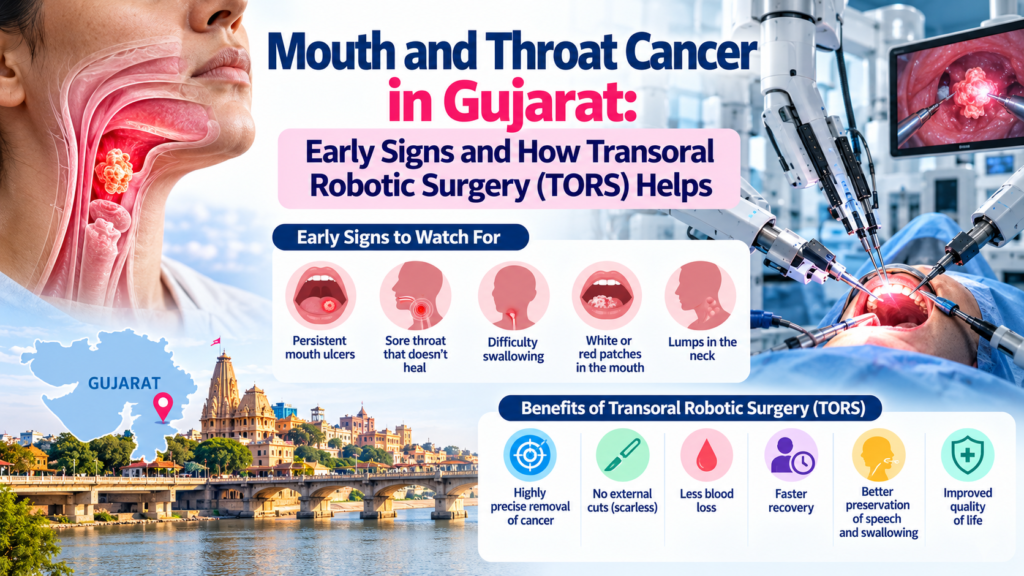
Early signs of mouth cancer you should not ignore
See a doctor if any of these last more than two weeks:
- A mouth ulcer that does not heal
- A white or red patch on the cheek, tongue, gums or palate
- A lump or thickening in the cheek or tongue
- Difficulty opening the mouth fully
- Loose teeth without a dental reason
- Bleeding or numbness in the mouth
Signs of throat cancer
- Persistent sore throat or pain on swallowing
- Feeling that something is stuck in the throat
- Change in voice or hoarseness lasting more than three weeks
- Ear pain on one side without an ear problem
- A painless lump in the neck
A neck lump in an adult that lasts more than a few weeks should always be checked by a specialist.
Who is at risk?
- People who chew tobacco, gutkha, mawa, khaini or paan with tobacco
- Smokers of cigarettes or bidis
- Regular alcohol drinkers, especially with tobacco
- People with HPV infection (linked to some throat cancers, including in non-smokers)
- Poor oral hygiene and sharp, broken teeth that keep rubbing the cheek or tongue
Quitting tobacco at any age lowers the risk.
How is it diagnosed?
The specialist examines the mouth and neck and may use a small camera (endoscopy) to see the throat. A biopsy, a small piece of tissue, confirms the diagnosis. CT, MRI or PET-CT scans show the size and spread of the cancer.
Treatment options
Treatment depends on where the cancer is and its stage. Options include:
- Surgery to remove the tumour and, when needed, the lymph nodes in the neck (neck dissection)
- Reconstruction to restore the shape and function of the mouth
- Radiation therapy, with or without chemotherapy
Most mouth cancers are treated mainly with surgery. Many throat cancers can be treated with surgery or radiation, and the choice is made by a team of specialists.
What is transoral robotic surgery (TORS)?
In TORS, the surgeon passes a camera and thin robotic instruments through the open mouth to reach tumours at the back of the throat, such as the tonsil, base of the tongue, and parts of the voice box area.
Traditionally, reaching these areas could require splitting the jaw or making large cuts in the neck. TORS avoids this for suitable patients.
Possible benefits of TORS:
- No cut on the face or jaw
- Less pain and a shorter hospital stay
- Faster return to swallowing and speaking
- In some patients, a lower dose of radiation, or no radiation, may be needed afterwards
TORS is not suitable for every tumour. Very large tumours, or those in areas the instruments cannot reach, need other approaches. Learn more about the full range of robotic head and neck cancer surgery, including scarless robotic thyroid surgery.
Life after head and neck cancer surgery
Speech and swallowing therapy, good nutrition and regular follow-up are part of recovery. Most patients return to a normal diet over time. Read our general recovery guide after robotic surgery.
Frequently asked questions
Is every mouth ulcer cancer? No. Most ulcers heal within two weeks. An ulcer or patch that does not heal must be checked.
Can mouth cancer be cured? Early-stage mouth cancer has good results with timely surgery. This is why early diagnosis matters.
Will my face look different after surgery? With TORS for throat cancer, there is no outside cut. For mouth cancers, surgeons plan reconstruction to keep appearance and function as close to normal as possible.
See a specialist early
Dr. Nitin Singhal, surgical oncologist trained at Tata Memorial Centre, treats head and neck cancers in Ahmedabad using open and robotic techniques, including TORS. If you or a family member has any of the signs above, book a consultation or call +91 75061 14222.