
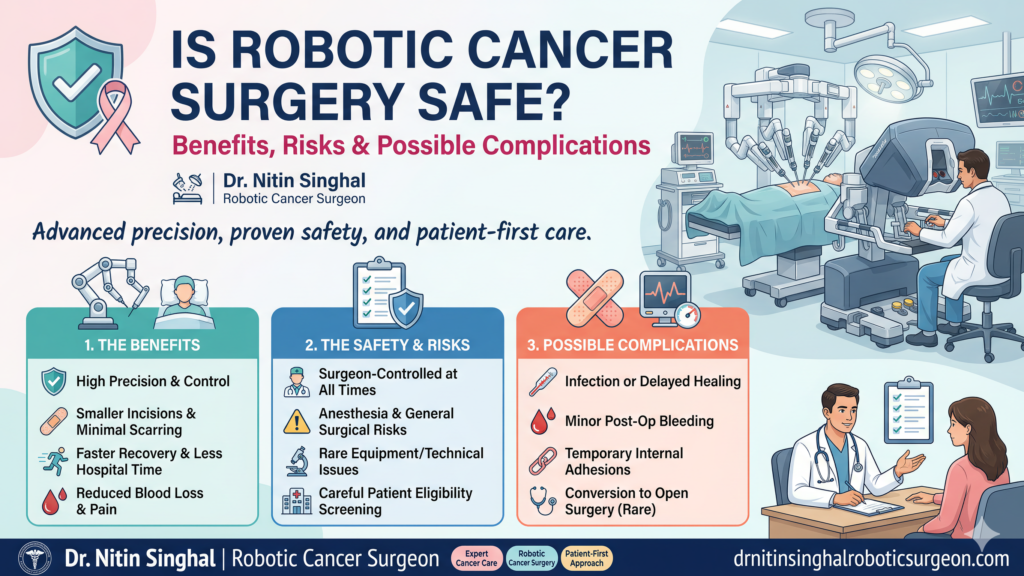
Quick Answer
Yes, robotic cancer surgery can be safe for carefully selected patients when it is done by a trained, experienced team in a well-equipped hospital. It may mean less blood loss and a shorter hospital stay than open surgery, but it is not automatically safer, it still carries surgical risks, and it has not been shown to improve overall cancer survival.
What Is Robotic Cancer Surgery?
Robotic cancer surgery is a minimally invasive surgical approach in which a trained surgeon uses a robotic-assisted system to perform an operation.
Instead of making one large incision, the surgeon generally makes several small incisions through which a camera and specialised surgical instruments are inserted.
The surgeon operates from a console, controlling the instruments through hand and foot movements. A high-definition, magnified three-dimensional view helps the surgeon visualise the operating area.
Unlike the common misconception, a robot does not independently perform the operation. The surgeon controls the instruments and makes all important surgical decisions throughout the procedure.
Robotic-assisted surgery may be used for selected cancer procedures involving the:
- Colon and rectum
- Prostate and kidneys
- Urinary bladder
- Uterus and other gynaecological organs
- Stomach and other gastrointestinal organs
The suitability of robotic surgery depends on the individual cancer diagnosis and the surgical requirements.
Is Robotic Cancer Surgery Safe?
Yes, robotic cancer surgery can be a safe and effective surgical option for appropriately selected patients when performed by a trained and experienced surgical team.
However, it is important to understand that robotic cancer surgery is not automatically safer than conventional laparoscopic or open surgery.
Its safety depends on five major factors:
| Safety factor | Why it matters |
| Surgeon’s experience | Specific training in robotic surgery and experience with your type of cancer operation. |
| Cancer type and stage | Tumour size, location and spread decide whether a robotic approach is suitable. |
| Your overall health | Diabetes, heart or lung disease and obesity affect planning and recovery. |
| Hospital facilities | A well-equipped theatre, skilled anaesthesia and nursing teams, and close monitoring after surgery. |
| Right patient selection | For some patients, laparoscopic or open surgery is the better and safer choice. |
Benefits vs Risks
Compared with a similar open operation, here is what robotic surgery may offer and what it still involves:
| Possible benefits | Risks that remain |
| Smaller incisions and smaller scars | It is still major surgery under general anaesthesia |
| Less blood loss during surgery | Bleeding can still occur, especially near large blood vessels |
| Less pain after surgery | Infection, blood clots and injury to nearby organs are possible |
| Shorter hospital stay | Recovery varies; complications can lengthen the hospital stay |
| Magnified 3D view, helpful in tight areas like the pelvis | The surgeon may need to switch to open surgery during the operation |
| Quicker return to daily activities for some patients | It cannot guarantee complete cancer removal or prevent recurrence |
How much benefit you get depends on the type of operation, your tumour and your general health.
Can Robotic Cancer Surgery Guarantee Complete Cancer Removal?
No. Robotic cancer surgery cannot guarantee complete cancer removal or prevent cancer from returning.
The primary objective of cancer surgery is to remove the tumour effectively while preserving healthy tissue and organ function whenever medically appropriate.
The success of the operation depends on cancer type and stage, tumour size and location, whether cancer has spread to surrounding structures, the ability to achieve appropriate surgical margins, lymph node involvement and the need for additional chemotherapy or radiotherapy.
Robotic technology assists the surgeon during the operation, but it does not change the biological behaviour of cancer. Patients should discuss expected cancer outcomes, surgical margins and the possibility of additional treatment with their surgical oncologist.
Who Is Eligible for Robotic Cancer Surgery?
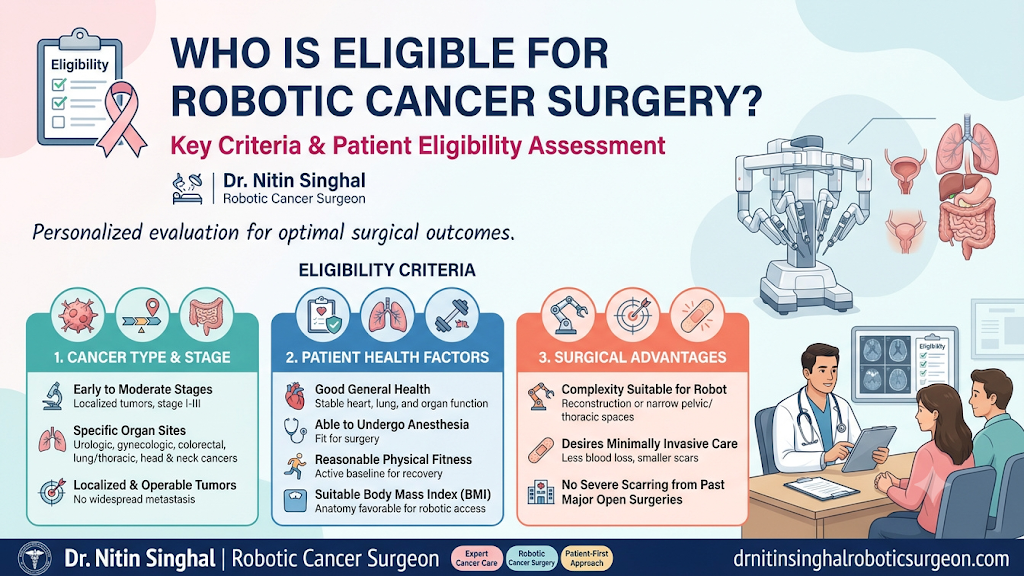
Robotic cancer surgery may be suitable for selected patients with different types of cancer. However, not every cancer patient is an appropriate candidate. A surgical oncologist evaluates several factors before recommending this approach.
| Evaluation factor | Why it matters |
| Cancer type | Different cancers require different surgical approaches. |
| Cancer stage | Determines the extent of treatment required. |
| Tumour location | Influences whether robotic instruments can access the surgical area. |
| Tumour size | May affect the feasibility of minimally invasive removal. |
| Previous surgeries | Previous operations may cause internal scar tissue. |
| Overall health | Determines fitness for major surgery and anaesthesia. |
| Treatment history | Previous chemotherapy or radiotherapy may influence surgical planning. |
Imaging investigations, biopsy reports, blood tests and clinical examinations help determine the most appropriate treatment. The final decision should always be personalised.
Which Types of Cancer Can Be Treated with Robotic Surgery?
Robotic Surgery for Colorectal Cancer
Robotic-assisted surgery may be considered for selected patients with colon and rectal cancer. The technology may help surgeons perform precise dissection in the pelvic region while working around important anatomical structures.
Robotic Surgery for Prostate Cancer
Robotic-assisted radical prostatectomy is an established surgical option for selected patients with localised prostate cancer. The procedure involves removing the prostate gland and, when indicated, surrounding tissues and lymph nodes.
Robotic Surgery for Kidney Cancer
Robotic-assisted partial nephrectomy may be considered for certain patients with kidney cancer. The aim is to remove the tumour while preserving the remaining healthy kidney tissue whenever appropriate.
Robotic Surgery for Gynaecological Cancers
Selected patients with endometrial, cervical and other gynaecological cancers may be candidates for robotic-assisted surgery. The appropriate procedure depends on the cancer type, stage and treatment requirements.
Robotic Surgery for Gastrointestinal Cancers
Robotic-assisted techniques may be used for selected stomach, oesophageal, pancreatic and other gastrointestinal cancer procedures. These operations can be complex and require careful evaluation by an experienced surgical team.
Not every patient with these cancers is suitable for robotic surgery.
What Should You Ask Your Surgeon Before Robotic Cancer Surgery?
Before choosing robotic cancer surgery, patients should understand the procedure, expected outcomes and possible complications. Here are seven useful questions to discuss during a consultation:
- Is robotic surgery appropriate for my particular type and stage of cancer?
- What are the benefits of robotic surgery compared with laparoscopic or open surgery in my case?
- How much experience do you have performing this specific robotic procedure?
- What are the possible complications and risks?
- Will the operation affect the function of nearby organs?
- How long might recovery and hospitalisation take?
- Will I need chemotherapy, radiotherapy or other treatment after surgery?
These questions can help patients better understand their treatment options and make informed decisions.
How Can Patients Reduce the Risks of Robotic Cancer Surgery?
Although no operation is completely risk-free, proper preparation and postoperative care can help reduce avoidable complications.
- Share your complete medical history with the surgical team.
- Inform doctors about all medications, allergies and previous operations.
- Complete recommended blood tests and imaging investigations.
- Follow fasting and medication instructions before surgery.
- Follow the prescribed wound-care routine after surgery.
- Start walking and physical activity when advised by the medical team.
- Attend scheduled follow-up appointments.
- Report unusual symptoms such as fever, increasing pain or wound discharge.
Seek emergency medical attention for chest pain, severe breathlessness or fainting after surgery.
Robotic Cancer Surgery in Ahmedabad: Choosing the Right Surgical Approach
For patients searching for robotic cancer surgery in Ahmedabad, choosing the right surgical oncologist is an important part of treatment planning.
Advanced surgical technology is valuable, but it should always be supported by appropriate clinical expertise, proper patient selection and a well-equipped surgical facility.
Dr. Nitin Singhal is a Surgical Oncologist based in Ahmedabad, Gujarat, with specialised surgical oncology training from Tata Memorial Centre, Mumbai.
His areas of surgical practice include gastrointestinal, colorectal, urological, gynaecological and other complex cancer surgeries, including selected robotic-assisted procedures and HIPEC.
Patients considering robotic cancer surgery can discuss whether robotic-assisted surgery is appropriate for their diagnosis, whether laparoscopic or open surgery may be more suitable, expected benefits and limitations, possible complications and recovery requirements, and whether additional cancer treatment may be needed.
A personalised consultation helps patients understand the available treatment approaches based on their diagnosis and medical condition. Patients from Ahmedabad and other parts of Gujarat can seek a specialist consultation to discuss their cancer treatment options.
Frequently Asked Questions About Robotic Cancer Surgery
Is robotic cancer surgery safe for cancer patients?
Yes, robotic-assisted cancer surgery can be safe for appropriately selected patients when performed by a trained surgical team. However, its safety depends on the cancer type, surgical complexity, patient’s health and surgeon’s experience.
What are the main benefits of robotic cancer surgery?
Potential benefits include smaller incisions, enhanced visualisation, reduced blood loss, less postoperative discomfort and potentially shorter hospital stays in selected procedures.
What are the possible complications of robotic cancer surgery?
Possible complications include bleeding, infection, injury to nearby organs, blood clots, anaesthesia-related problems and technical difficulties. The risk varies depending on the procedure and the patient’s condition.
Is robotic cancer surgery better than open surgery?
Robotic surgery may offer advantages such as smaller incisions, reduced blood loss and faster recovery in selected procedures. However, open surgery may be more appropriate for certain complex or extensive cancers. The best approach depends on the individual patient.
Does robotic cancer surgery completely remove cancer?
Robotic technology assists the surgeon in removing the tumour, but it cannot guarantee complete cancer removal. The outcome depends on the cancer’s extent, location, surgical margins and other clinical factors.
How long does recovery take after robotic cancer surgery?
Recovery time varies depending on the type of cancer, extent of surgery and the patient’s general health. Some patients recover sooner following minimally invasive surgery compared with open procedures.
Can advanced-stage cancer be treated with robotic surgery?
Robotic-assisted surgery may be considered in selected advanced cancer cases, depending on tumour involvement, the possibility of complete removal and the patient’s overall condition. A specialist evaluation is essential.
Is robotic cancer surgery performed by a robot?
No. The operation is performed by a trained surgeon who controls the robotic-assisted system throughout the procedure. The technology does not independently perform surgery.
How do I find a robotic cancer surgeon in Ahmedabad?
Look for a surgical oncologist with appropriate training and experience in the specific robotic procedure being considered. Discuss the surgeon’s experience, hospital facilities, treatment alternatives and expected outcomes during your consultation.
Conclusion
Robotic cancer surgery is an important development in modern surgical oncology. It may offer several benefits, including smaller incisions, reduced blood loss, less postoperative discomfort and potentially faster recovery for appropriately selected patients.
However, robotic-assisted surgery also carries risks and possible complications. It is not suitable for every cancer patient, and it does not guarantee better cancer survival or complete tumour removal.
The most important factor is choosing the surgical approach that offers the most appropriate treatment for the patient’s individual diagnosis.
If you are considering robotic cancer surgery in Ahmedabad, consult an experienced surgical oncologist to understand the benefits, risks and alternative treatment options.
Meet the Expert
Dr. Nitin Singhal is a robotic and surgical oncologist in Ahmedabad. His clinical practice includes the surgical management of cancers involving the abdomen, chest, head and neck, breast, and gynaecological and urological organs.